Let agents write the code. Keep the process yours.
LLM agents are flexible, and that is exactly why you can’t predict them. Cloche puts that flexibility inside a workflow that is predictable: the same steps, in the same order, with the same checks, on every task. You get to say for certain what your system does, even though an agent is doing the work.
Deterministic where it counts
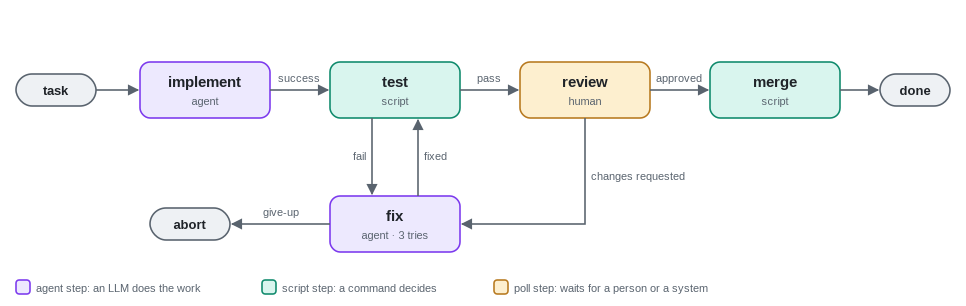
An agent decides how to do a step. It never decides what happens next. Every step ends in a named result, every result is wired to exactly one place, and the whole graph is checked before anything runs. So you can make promises about your pipeline that a prompt alone can’t keep: nothing merges without review, a fix gets three tries and then stops, a deploy only ever follows a green build.
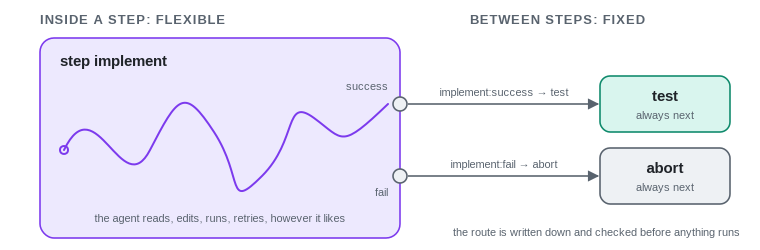
The route lives in a file you wrote, not in a model’s judgement:
implement:success -> test
test:success      -> review
test:fail         -> fix
fix:success       -> test
fix:give-up       -> abort
That’s a bounded retry loop. The whole language fits in an afternoon.
Your code stays untouched until you say so
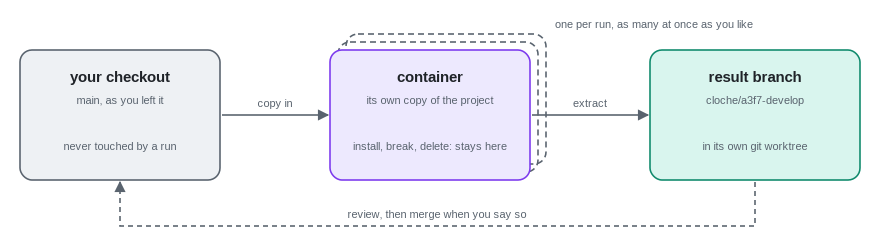
Each run gets its own container and its own copy of your project. Agents can install things, break things, and delete things, and none of it reaches your checkout. What comes back is a git branch in its own worktree: review it, merge it, or throw it away. Ten runs at once never step on each other.
Any language, any stack
Cloche doesn’t know or care what you’re building. If it runs in a Docker container and has a command that tells you whether it works, Cloche can drive it. Go, Rust, Python, Ruby, a monorepo, several repositories at once — bring your own Dockerfile and your own make test.
Any agent — and a different one for every step
Claude Code, Codex, or anything that reads a prompt and reports a result. Give the hard implementation step to your strongest model, the review to a second opinion from a different vendor, and the commit message to something cheap. Set agents per step, chain fallbacks for when one is down, and switch providers by editing one line.

Not everything should be an LLM call
Agents are one kind of step. Scripts are another: a command gives the same answer every time. A poll step waits for a human review or a CI run, for days if it has to, without holding a slot. Fan out to lint, tests, and a security scan in parallel, then join. Use the right tool at each stage and pay for a model only where you need one.
See your process, and watch it run
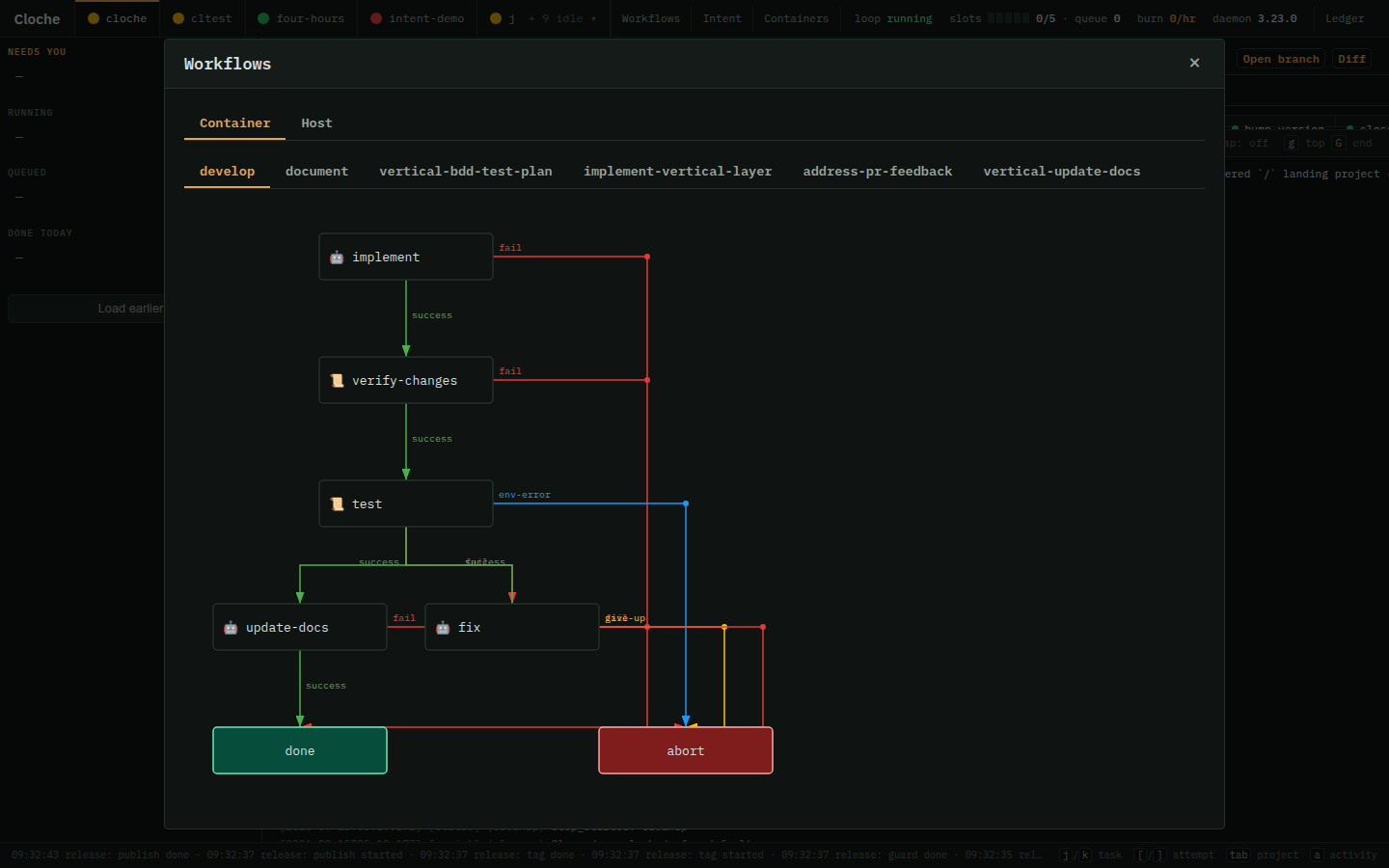
Your workflow isn’t buried in a prompt. The web console draws it as a graph — every step, every wire, the prompt behind each node — and shows each run moving through it, with live logs and the exact input every step was given. cloche workflow draws the same graph in your terminal. A Needs you list collects whatever is waiting on a human — stale claims, tasks that keep failing — so everything else keeps moving.
Point it at a backlog and walk away
The orchestration loop pulls tasks from beads, GitHub Issues, or anything that can print a line of JSON, and works through them — several at a time if you like. Swap trackers by changing one file. Feed it signals and a red main or a production error becomes a task on the pile without anyone filing it.
No surprise bills
Token limits per step and per workflow stop a runaway agent. A daily budget cap stops the whole fleet before it eats your week’s allowance. When a run fails at step five, resume from step five — not from the top.
Ready to try it? Install Cloche and run your first workflow in minutes.